
CaveUT
We no longer support CaveUT, but it remains useful, and several installations still use it. Our friends at the Intelligent Virtual Environment Lab (IVL) at the University of Teeside are working on a new way to use the modern Unreal Engine for immersive displays. We will announce it here as it is ready for public release.
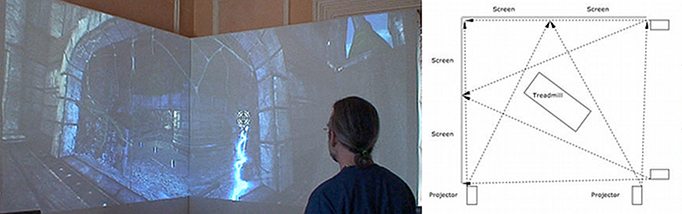
CaveUT is a set of free modifications to the game, Unreal Tournament 2004 as a software platform for CAVE multiscreen immersive displays. The screens can be assembled in any configuration, with one computer per screen connected over a small local LAN. CaveUT will make sure the views are synchronized to create the illusion of a contiguous virtual world. CaveUT can be used by itself, but is much more capable when used with VRGL.
It also provides a cursor that can moved across all screens of the composite display. It allows the user to select active objects to trigger events, which the developer has to program. When used with VRGL, CaveUT can support multi-projector dome displays like the Earth Theater. Our installation of CaveUT comes with a separate package, UtVRPN, which allows the user to control viewpoint movement via a UDP connection. You can get the final version here, along with VRGL, and utVRPN, here:
CaveUT_VrpnUT_VRGL_Logger_8_5_0_1_1.zip
The best general documentation we have is the last CaveUT themed paper we wrote (Jacobson and Preussner, 2010). CaveUT was first conceived of in 2000 and released in 2001. While it never gained wide use, it did achieve notoriety as a learning tool and a demonstration of how low cost commodity hardware can be used for virtual reality. We used it as the basis for most of our work for a decade. The history of CaveUT can be seen in our publications from 2001 to 2011.
Look here for older versions of CaveUT.
Credits for Version 2.0+
Jeffrey Jacobson: CaveUT was his big idea; general design and project management, testing and integration; provided content and wrote the rough draft of this web site; performed view rotation mathematics and wrote OpenGL code for CaveUT 1.1.; performed the physical design of the V-Cave design and provided instructions for replicating it.
Our utmost thanks to Epic Games for providing to us a read-only license to every version of their Unreal Engine, a powerful software platform for graphics rendering, physics, and networking. This has made development much easier over the years.