Virtual Theater District of Pompeii
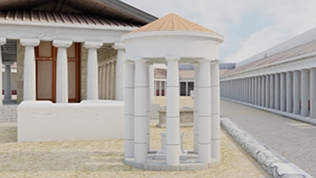
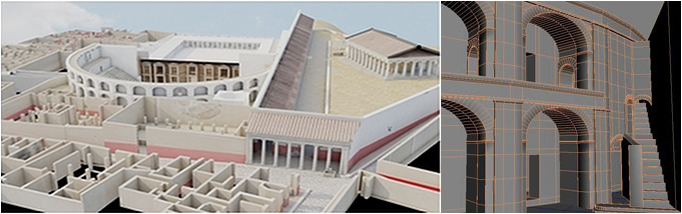
We have reconstructed the Grand Theater, the Triangular Forum, and the connecting areas of the Theater District in the Roman city of Pompeii as an interactive three-dimensional model. The model is the central reference tool of the information we are compiling on the archeological site (Weis, 2010). Our goal is to produce an online (web) site, which will integrate the model, original photographs, historical photos and drawings, written materials, and more. Our scholarly goals are: (1) Demonstrate how the connecting areas of the theater district functioned in the larger architectural space. (2) Illustrate the evolution of this popular long-uncovered site, as a physical and cultural artifact. We are interested in how it has changed in the popular and scholarly imagination over the years. (3) Demonstrate best practices in information access and presentation. (4) Provide all software and source materials to the public. (5) Provide a virtual stage for live mixed reality theater and recreations of dramatic performances.
Publications
Hawkins, J., Jacobson, J., Franklin, J. (2011) Greco-Roman Music in Context; Bringing Sound and Music to Virtual Pompeii, World Conference on E-Learning in Corporate, Government, Health Care, and Higher Education (E-Learn), Honolulu, Hawaii, October, 2011. PDF
Weis, A., Jacobson, J., Darnell, M. (2010) The Virtual Theater District of Pompeii. Computer Applications in Archaeology (CAA), Granada, Spain, April, 2010 PDF
Jacobson, J., Vadnal, J. (2005p) The Virtual Pompeii Project. World Conference on E-Learning in Corporate, Government, Health Care, and Higher Education (E-Learn) Vancouver, Canada, October 24-28. PDF
Old Versions
We built Version 3.0 of the Theater District Model in UT2004 as an intermediate step. Click the image below to see screenshots and to download the source. 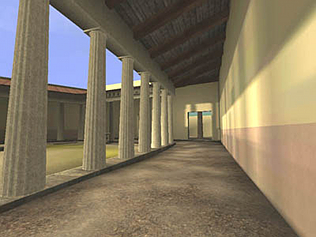
Version 2.0 of the Theater District is very similar to the original Pompeii Project (version 1.0) developed at Carnegie Mellon's Studio for Creative Inquiry in 1995-1996. It was technically advanced for its day, but lacked supporting materials. PublicVR sponsored conversion of the original model to VRML format and made some improvements to the artwork (Jacobson, 2005). Version 2.0 was incorporated into an early version of larger exhbit, "A day in Pompeii," during is showing at the Gulf Coast Explorium Science Center, Mobile, Alabama (January-June, 2007). For access to the models and more details, see: http://publicvr.org/PompeiiVRML/.